A structural shift is taking place in the payments industry, whose underlying architecture has remarkably barely changed in decades.
Every layer of today’s payment stack assumes a human at both ends of every payment, which for most of human history has been true, up until recently. Increasingly, however, AI agents are now facilitating economic value, slowly but surely gaining more autonomy in the payments loop, to the point where they are initiating payment flows themselves. In some contexts, these flows involve AI agents moving value on behalf of their human operators to perform simple consumer shopping tasks. This has been tried with initiatives like Instant Checkout in ChatGPT. In other contexts, AI agents are themselves making decisions to pay for things, particularly resources required for them to complete specific workflows. This means that alongside the human-to-human payment flow now sit the human-to-agent and agent-to-agent payment flows, and this seemingly simple shift is already reshaping how existing infrastructure providers compete.
Some projections forecast trillions in agentic commerce-driven volume over the next 5-10 years, and while today’s numbers reflect that we are in the early stages of this cycle, over a long enough time horizon the projections look at least directionally correct. And as the development pace of frontier labs research over the past several years has demonstrated, a lot of things happen in AI much quicker than expected. More importantly, in an industry whose incumbents have absorbed every wave of innovation for the past seventy years, the opportunity for a differently positioned player to own more of the stack does not come along very often.
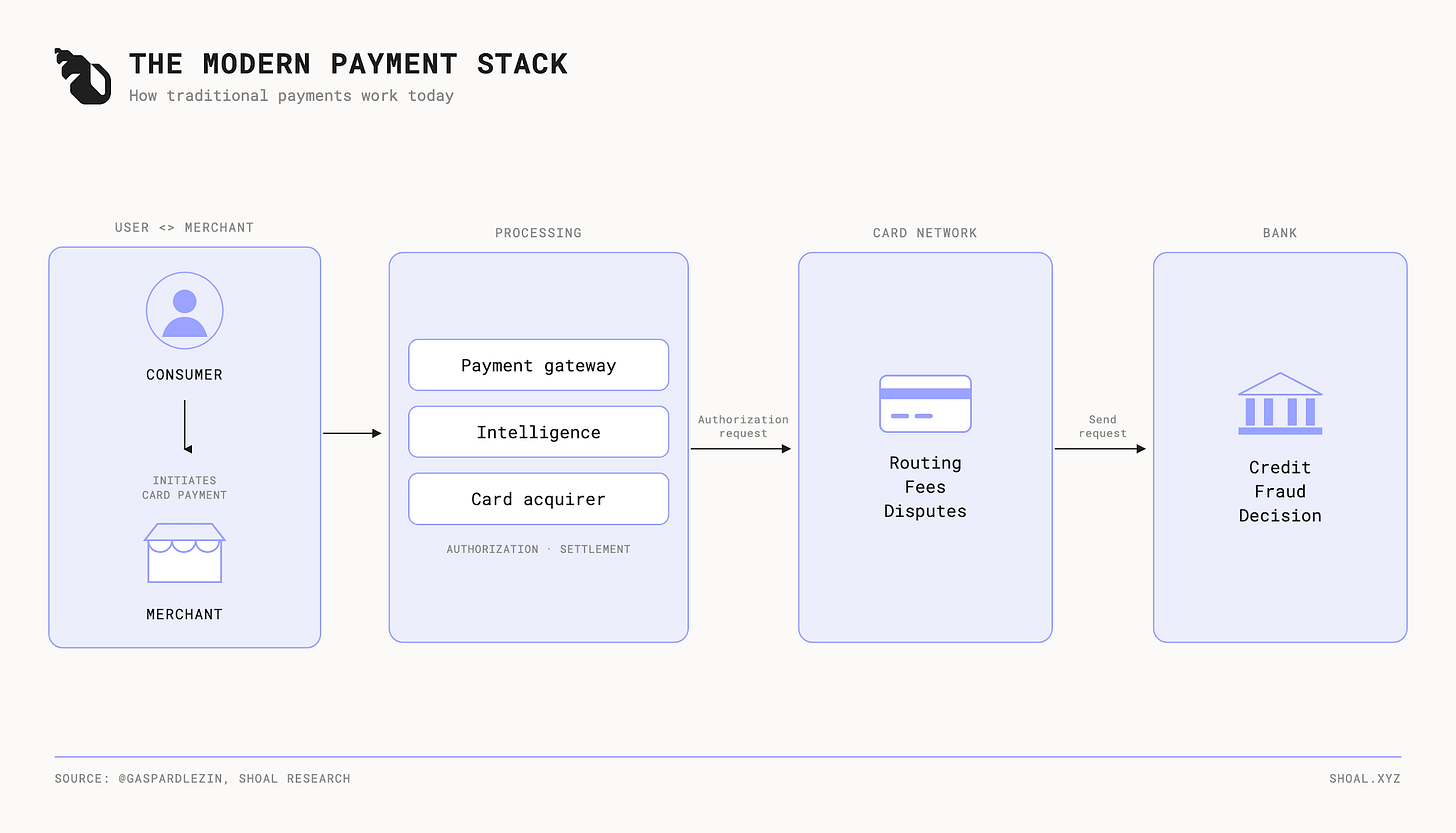
To understand the broader impact of this transformation, it helps to first understand what payments actually look like today. What feels instant to a consumer actually moves through four layers of infrastructure and five or more companies before a merchant ever sees a cent. This is often referred to as the “payments layer cake”, where each layer represents a different party in the payments flow.
When a consumer taps their card at checkout, the transaction moves through four distinct layers. At the top, the consumer initiates a card payment to the merchant. It drops into the processing layer, where a gateway (e.g., Stripe) encrypts and forwards the data, fraud and dispute intelligence runs in parallel, and a card acquirer (e.g., Adyen) prepares to receive funds on the merchant's side. From there, the authorization request hits the card network layer, where a Card Network like Visa or Mastercard handles routing, enforces scheme rules, and passes the request down to the banking layer. The issuing bank makes the credit and fraud decision and sends an approve or decline back up the chain. Authorization completes in under roughly two seconds, while settlement, the actual movement of funds back through the network to the acquirer and into the merchant's account, takes another one to two business days.
Each layer of this payment stack serves a fundamentally different customer; issuers extend credit to consumers, acquirers give merchants a way to accept payment, and the fraud and dispute layers sort out the mistakes people inevitably make. Serving all of these customers at once is beyond the reach of any single company; hence, no one has owned the whole stack. But a lot of this logic starts to break down when humans are further removed from the payments loop and, in their place, autonomous software programs take on a growing share of the decisions and transactions within it.
The payments industry has taken in one innovation after another, and the basic architecture has survived nearly all of them. When the credit card was introduced, it got rid of the need to carry cash, but instead of replacing any of the existing arrangements it simply added a consumer credit feature on top of the original banking system. The internet went even further by completely altering the way people contacted merchants and at the same time created a kind of fraud exposure that had never been there before, although the trust mechanisms developed in response were still based on the same four-party model. Likewise, companies such as Stripe and the fintechs that came after them, who reduced a large part of the system to a single API call, left the fundamental acquiring, issuing, and settlement processes unchanged.
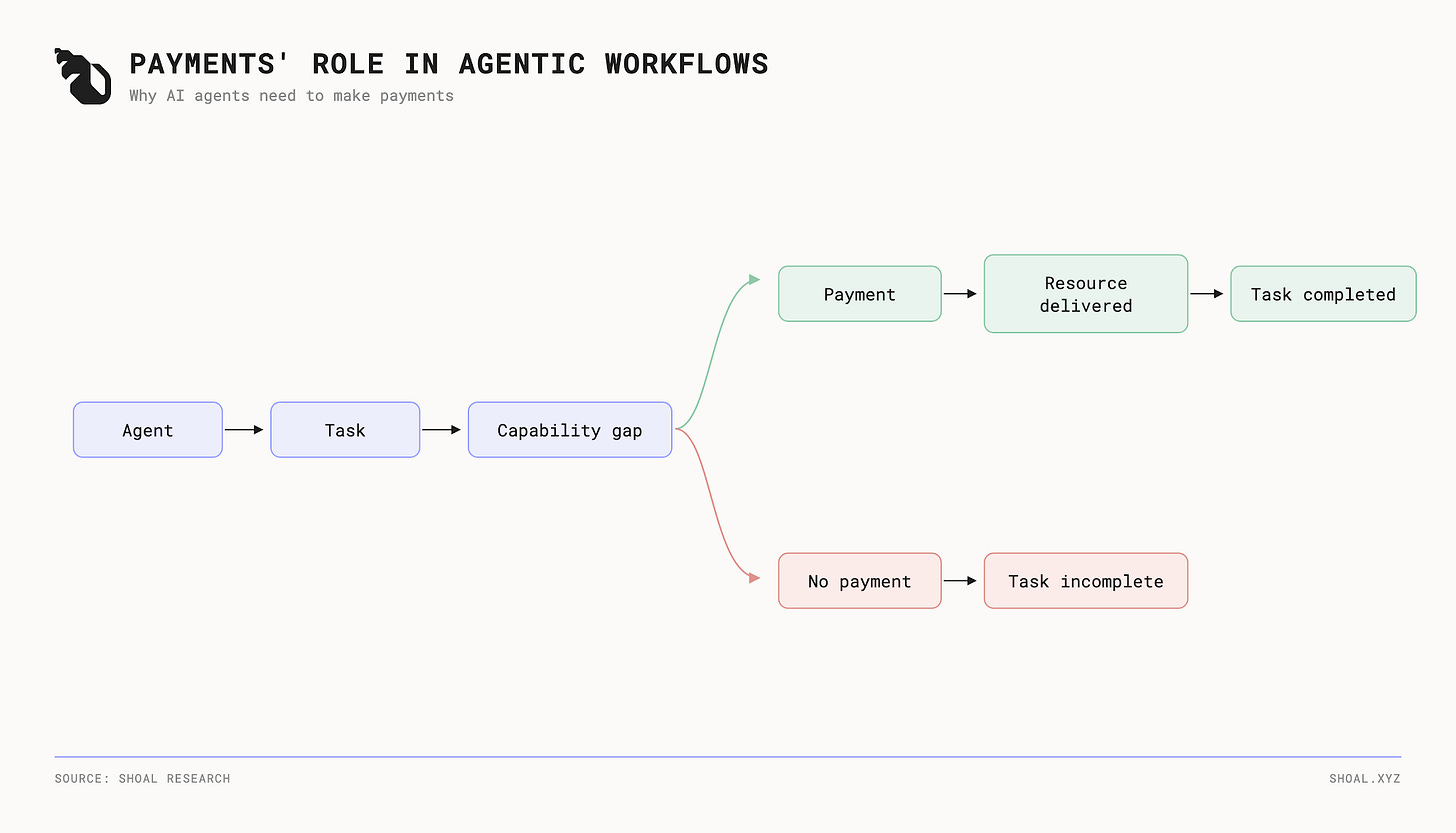
Every one of these developments, though, shared the same premise: optimizing a stack built for human consumers. AI agents break that premise, as they don't carry wallets, don't click checkout buttons, and don't face the cognitive constraints the human payments stack was designed around. For an agent, a payment is a function call within a workflow, where it requests a resource, receives a price, completes the payment, and moves to the next task. The human payment stack will not hold its shape around a loop that fast and frequent, especially at scale.
Vertical integration in payments, owning as much of the stack as possible, is not a new idea. Apple owns the iPhone, the Wallet app, and the tap-to-pay experience. Shopify runs the store and the checkout, processes the payment, and even lends money to its shops. Block controls everything from the card reader in a merchant's hand to the Cash App on a consumer's phone. But each of them still operates inside the human system, where every layer they own serves a specific customer segment with specific needs
Agents change the motive for integrating, because they change fundamentally what a customer is. An agent needs a place to keep its money, a way to send payments, and a way to find goods and services to buy. Not much else is needed beyond those key functions, so the payments stack it depends on is far smaller than the one built for human shoppers.
The question then becomes, given a narrower, purpose-built payments stack, which business in payments today can vertically integrate, and how far? The human payment stack is split across extending credit, accepting funds, routing the transaction, and settling it, each piece owned by a different company. The agent stack has no such divisions. An agent pays in the same dollars from start to finish, and the wallet, the network, and the shop are just ways of moving them, swappable for one another. The dollars make up the payment itself, giving the issuer of those dollars a particularly important role in agentic commerce.
Few players sit in this position, and while banks hold the actual dollars in the payment flow, an agent can't pay with a dollar sitting in a bank account. One emerging solution is to let the agent pay with a stablecoin, a digital version of a dollar that is issued on a blockchain. Bridging the two is a narrow business, where a company takes in a real dollar, holds it in reserve, and puts a digital dollar into circulation against it. From that point, the digital dollar is the company's product, and the rules it writes for how that dollar is made, moved, or frozen follow it everywhere it goes. That is why we believe a stablecoin issuer in particular is uniquely positioned to verticalize agent payments and capture the upside.
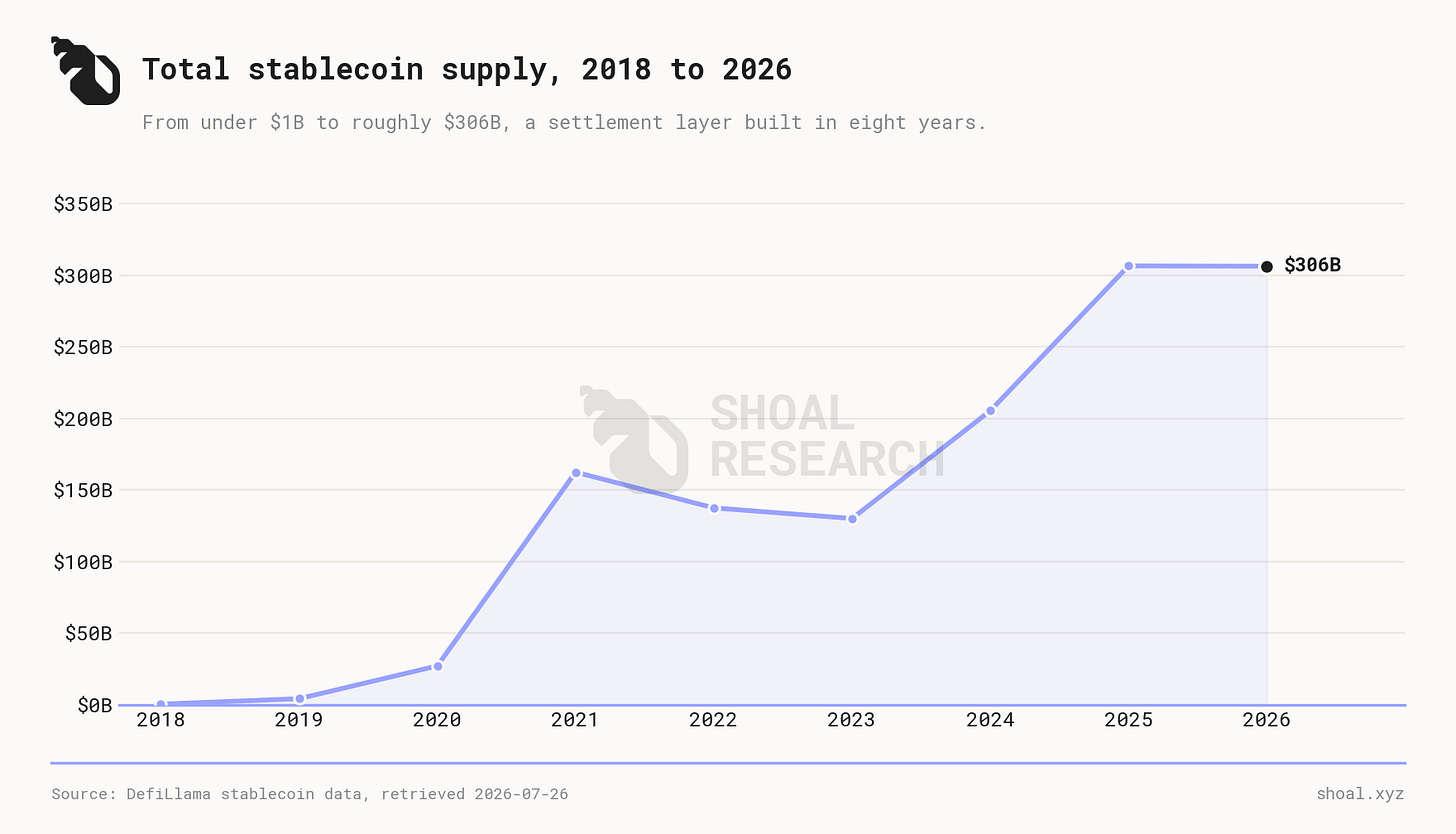
A stablecoin is, sparing some technical details, a piece of software programmed to maintain the value of a stable unit of exchange, most commonly a fiat currency like the US Dollar. A function call is made to a smart contract (another piece of software) and in turn a stablecoin is either minted or redeemed. Stablecoins are held and transacted through digital wallets; interfaces that bundle together a public key for sending and receiving transactions with a private key for authorization. The total circulating stablecoin supply sits at $315B at the time of writing as per Artemis.
The two primary reasons stablecoins are particularly well-suited for agents are economic and structural. A stablecoin transaction is a redistribution of balances on a blockchain, with no intermediary charging a fee at each layer between sender and recipient, which makes it orders of magnitude cheaper than legacy payment rails. The only resource consumed is the computing power needed to update the balance, paid as a gas fee that now sits in the sub-cent range across the majority of the leading chains by DEX volume.
Beyond cost, stablecoins have properties that fit how agents actually operate. Speed and accessibility are the obvious ones, since transactions settle in seconds and run around the clock. The more distinctive advantage is programmability. Stablecoins are issued and redeemed by smart contracts, pieces of code that execute automatically when predefined conditions are met, and those conditions, a collateral requirement, a spending limit, can be written directly into the contract. An agent can control its own wallet and sign transactions itself, so no human credential is needed at the payment layer. A payment becomes a function call in code, triggered the moment a condition is met, with no human initiating it.