A special thanks to Lucas and Kevin for their feedback and review.
In 1849, tens of thousands of men went searching for gold in California. Some made out to be kings. Most made out poor. But the greatest success fell upon the merchants building picks and shovels: the foundational tools that would remain important so long as there was gold in the ground. Today’s gold rush is AI. Payments are becoming a foundational part of AI agent workflows, and inevitably, the rails facilitating those payments become today’s picks and shovels. In this paper, we dive deep into the x402 protocol; one particular emerging open agent-native payment rail, including what it is, how it works, where adoption stands today, and what open questions face x402 when machines move money.
History is defined by seismic shifts. Sudden, profound transformations that change the very foundation of life itself. The physical geography we inhabit today was formed some 175 million years ago when the Earth’s tectonic plates shifted and broke apart. Tectonic plates are still shifting today, albeit much slower, but the biggest seismic shifts in the modern world have materialized through human innovation.
Foundational inventions, be it the Sumerian wheel, the Gutenberg press, the steam engine yield a similar reinforcing flywheel: humans build machines, these machines yield economic surplus, which leads to more money for building more machines (and better ones at that) which further compounds the output. As technology improves, the cost of experimentation falls while the rate of iteration increases. We’ve seen this dynamic accelerate particularly within the last few decades with computers and the applications and services built around them.
Today this transformative dynamic is materializing through software, particularly artificial intelligence.
AI has been around for a long time. The first paper on neural networks was published as far back as 1943. Expert systems in the 80s and statistical machine learning in the 90s quietly embedded AI into production workflows, from credit scoring to ad targeting.
Spam filters, recommendation engines, and fraud detection have been running on machine learning models since the early 2000s. What changed is the interface. Generative AI lets humans interact with these systems through free-form natural language, and that shift in accessibility is what brought AI into mainstream consumer markets.
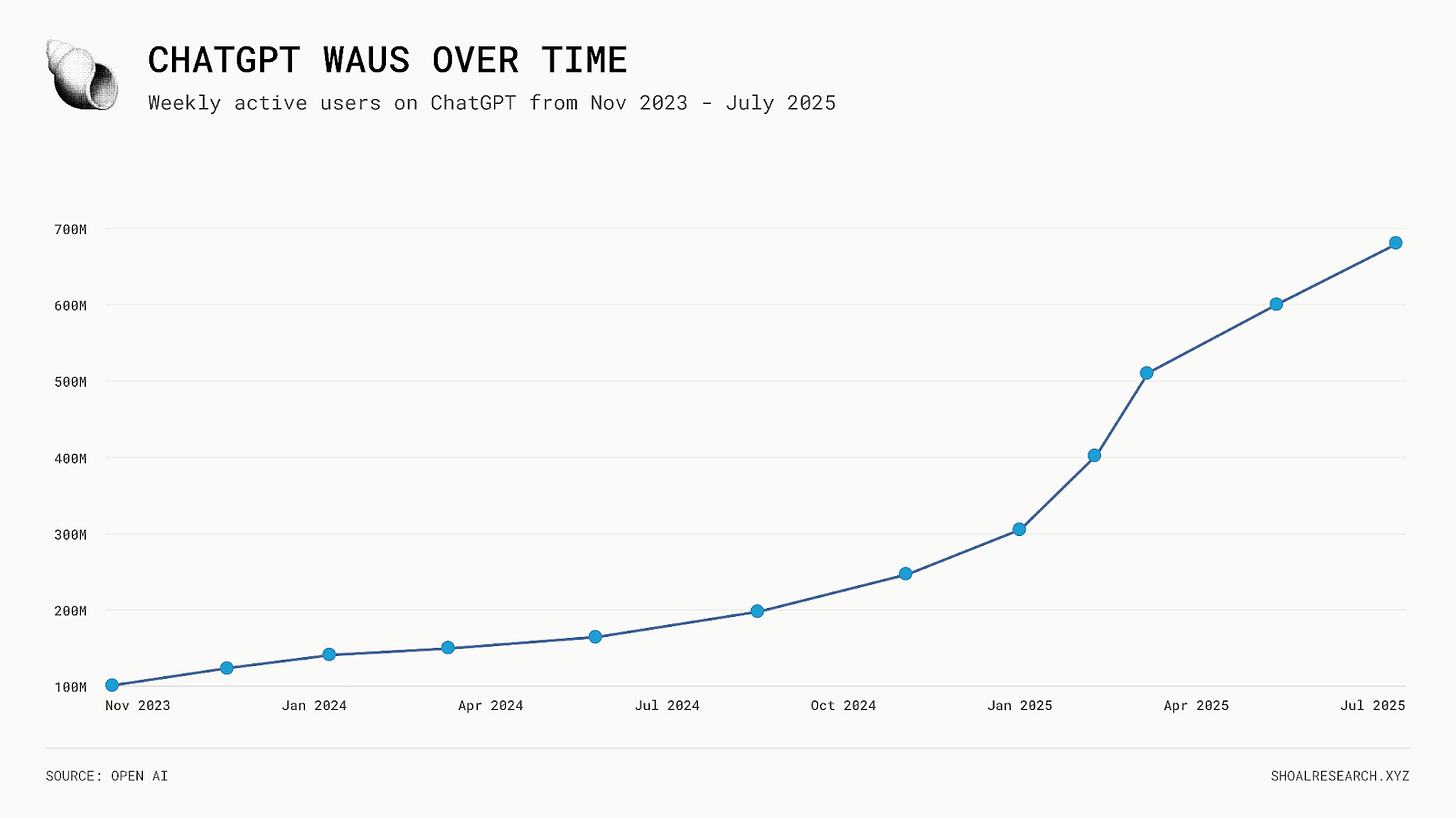
OpenAI launched ChatGPT as a simple and intuitive way to interact with its underlying GPT models, which reached 1 million users in 5 days and 100 million in 2 months, the fastest consumer internet adoption in history. Shortly after competing generative AI applications (e.g. Gemini, Claude, Grok) started rolling out, and the ensuing competition drove major AI labs to quickly improve models and ship new product features. On a darker note, fears of job displacement have mounted as corporate executives continue to iterate reducing headcount and increasing investments in AI (though it’s worth noting over half of US workers today are working jobs which didn’t exist in 1940).
No one can state with certainty how AI will ultimately reshape society. But as of late 2025, roughly one in six people worldwide have used generative AI, a technology that barely existed three years ago. While early, a seismic shift is well underway.
But there’s only so much to be done by simply talking to AI. Read access, e.g. letting LLMs look things up, condense large bodies of text, write code, analyze data, is evidently useful but only goes so far. But pairing that with write access, in other words letting AI actually do things across external environments, has unlocked an entirely different set of capabilities.
In 2025, OpenAI rolled out Operator and Codex, Anthropic shipped Claude Code, Perplexity launched Comet, Google embedded Gemini-powered agents across Workspace applications, Microsoft pushed Copilot deeper into Office and Windows. Perplexity, Cursor, Sierra, and Cognition each raised hundreds of millions in new funding and reached new all fun highs in revenue. It’s clear that agents will define the next chapter in how humans interact with AI.
But an overlooked reality is that autonomous agents have been driving economic activity online for years. The digital ads marketplace is one massive agentic economy operating beneath the surface of nearly every ad-supported webpage (which includes most large consumer sites and platforms today).
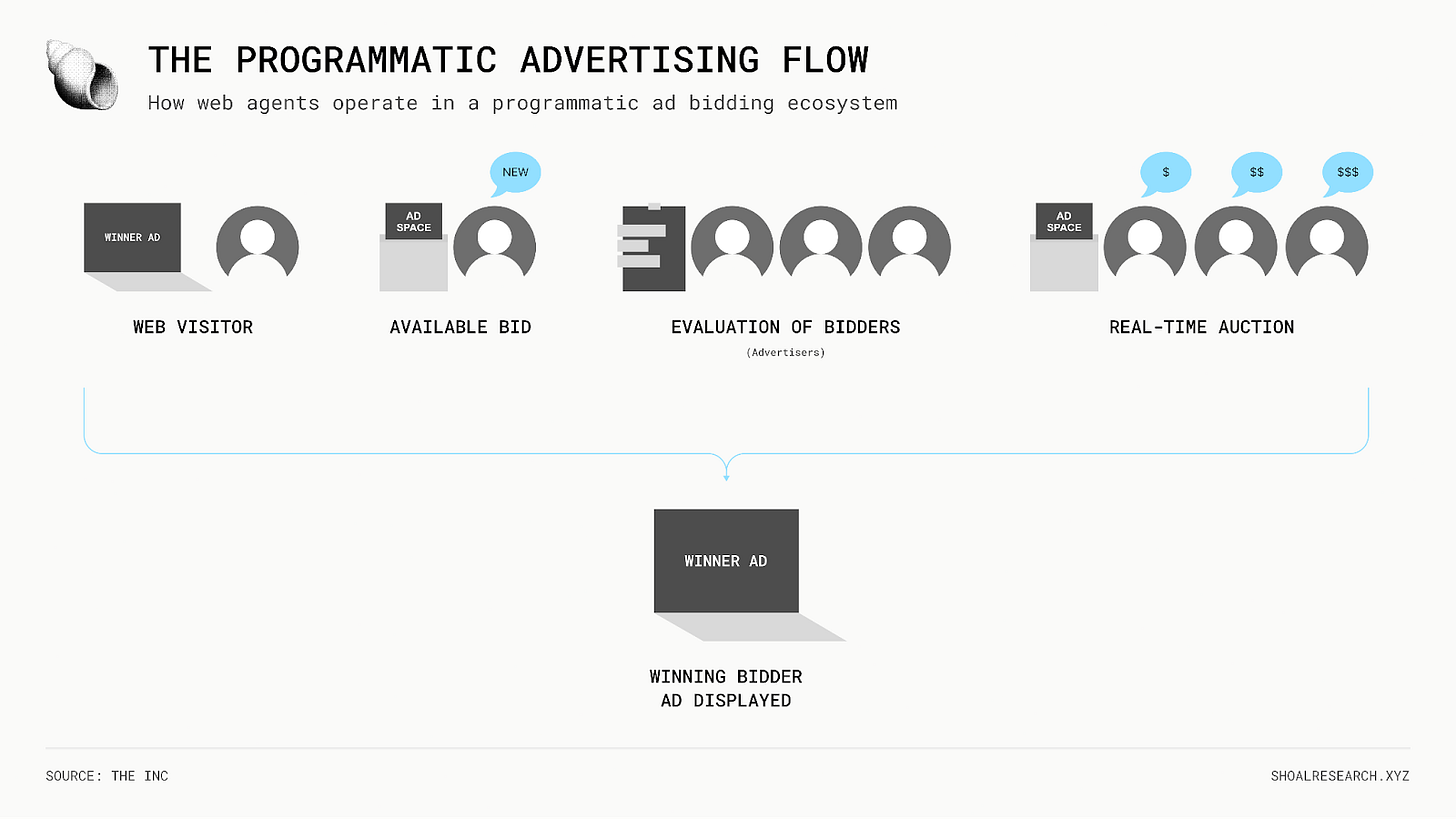
Whenever someone loads a site, the empty ad space is put up for sale in a mini-auction, and agents operating on behalf of advertisers (this could be any merchant selling goods online) determine how much that ad space is worth to them and submit bids. The highest bid wins and the winning ad is rendered in the slot, within hundreds of milliseconds. By the time the site loads, the ad is already displayed. To put this scale into perspective, consider that programmatic digital ad spend amounts to hundreds of billions annually, which accounts for over 90% of display ad budgets today.
Crawlers are another example. These autonomous agents roam the web, follow URLs, fetch webpages, and feed that content into large-scale indexing and training pipelines. Similarly, scrapers extract raw data from webpages and are actively used in a variety of fields today. On a darker note, “bad bots”, programs set up to exploit business logic online, accounted for as much as 37% of internet traffic in 2025. Collectively, over half of all web traffic is already run by autonomous software agents.
Yet evidently, few people know about these agents, and even fewer actually use them. However useful these agents may be at their particular function, e.g. bidding for ad space, their utility is limited by their purpose-built nature. A crawler crawls, a scraper scrapes, a bidder bids, and nothing more.
When these different capabilities are stacked together into one single program, controlled from one single interface, the nature of the application changes entirely. This is where the general-purpose AI agents most people know today come in. Their most foundational change is their ability to perform many different tasks and operate across multiple apps and environments within one interface. These agents were designed to accelerate human output and productivity: they do more things, at a much greater rate, and as their adoption grows, they generate an ever larger share of web traffic.